Reviewed by Tyler Kurr, General Manager of Mr. Spring Garage Doors. Last updated August 12, 2026.
Quick answer: that loud bang from your garage was almost certainly a broken spring. It’s the most common garage door failure there is, it’s contained and not an emergency in the safety sense, and it’s a same-day fix. Here’s how to confirm it, what to do (and not do) right now, and what it costs to get fixed.
A torsion spring breaking sounds like a gunshot or a car backfiring, one of the most startling sounds you’ll hear come out of your garage. It often happens overnight or catches people off guard on an otherwise ordinary morning.
Here’s what’s actually happening: a torsion spring is wound tight enough to store hundreds of pounds of tension. When it snaps, all of that energy releases in an instant. The spring itself almost always stays on the shaft above the door, it doesn’t fly off, but the sound of that sudden release carries through the whole house.
Extension springs, the type that run along the side tracks instead of above the door, break differently. It’s more of a dull twang than a bang, and if the spring doesn’t have a safety cable threaded through it, a snap can send it across the garage.
After the bang, the door typically does one of three things: it won’t move at all, it lifts a few inches before the opener stalls, or it goes up partway and drops back down. All three are consistent with a broken spring.
This happens most often in cold weather. Minneapolis and St. Paul’s January-through-March stretch is peak spring failure season. Metal fatigue builds up faster when temperatures swing, and cold-thickened lubrication adds resistance to every cycle, both of which push a spring that’s already near the end of its life past the breaking point. According to Minnesota DNR climate normals, Minneapolis and St. Paul average about 22 days a winter with lows at or below zero, more than enough cold-snap mornings to catch a fatigued spring at its weakest.
A few checks, in order of how obvious they are:
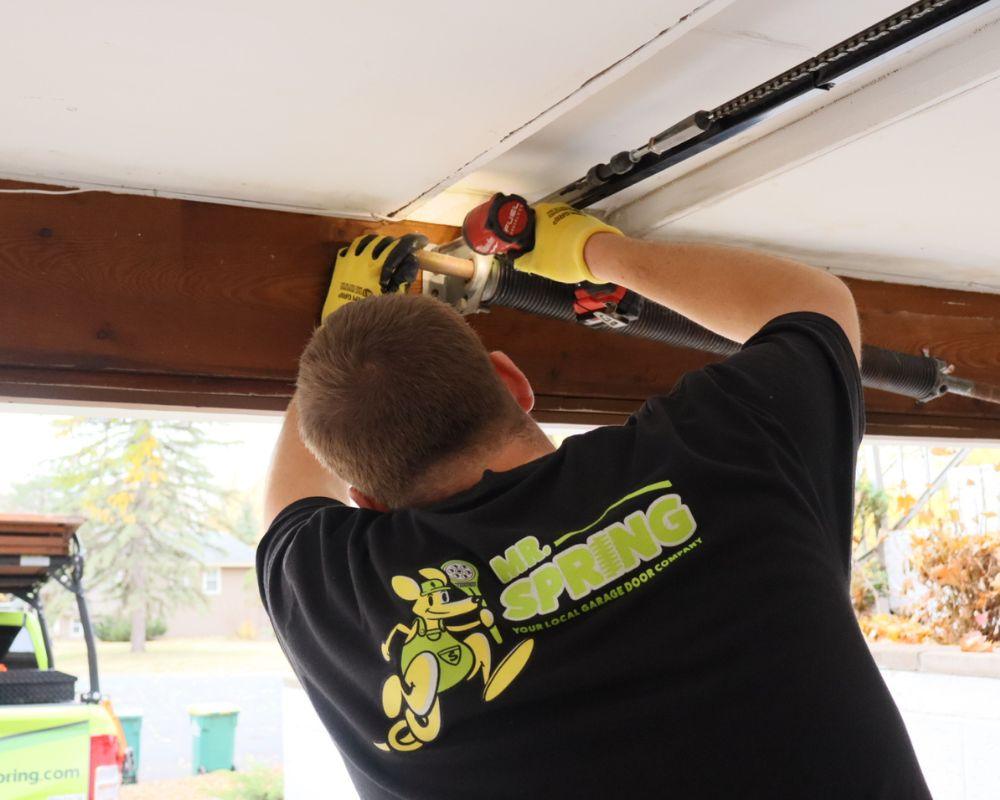
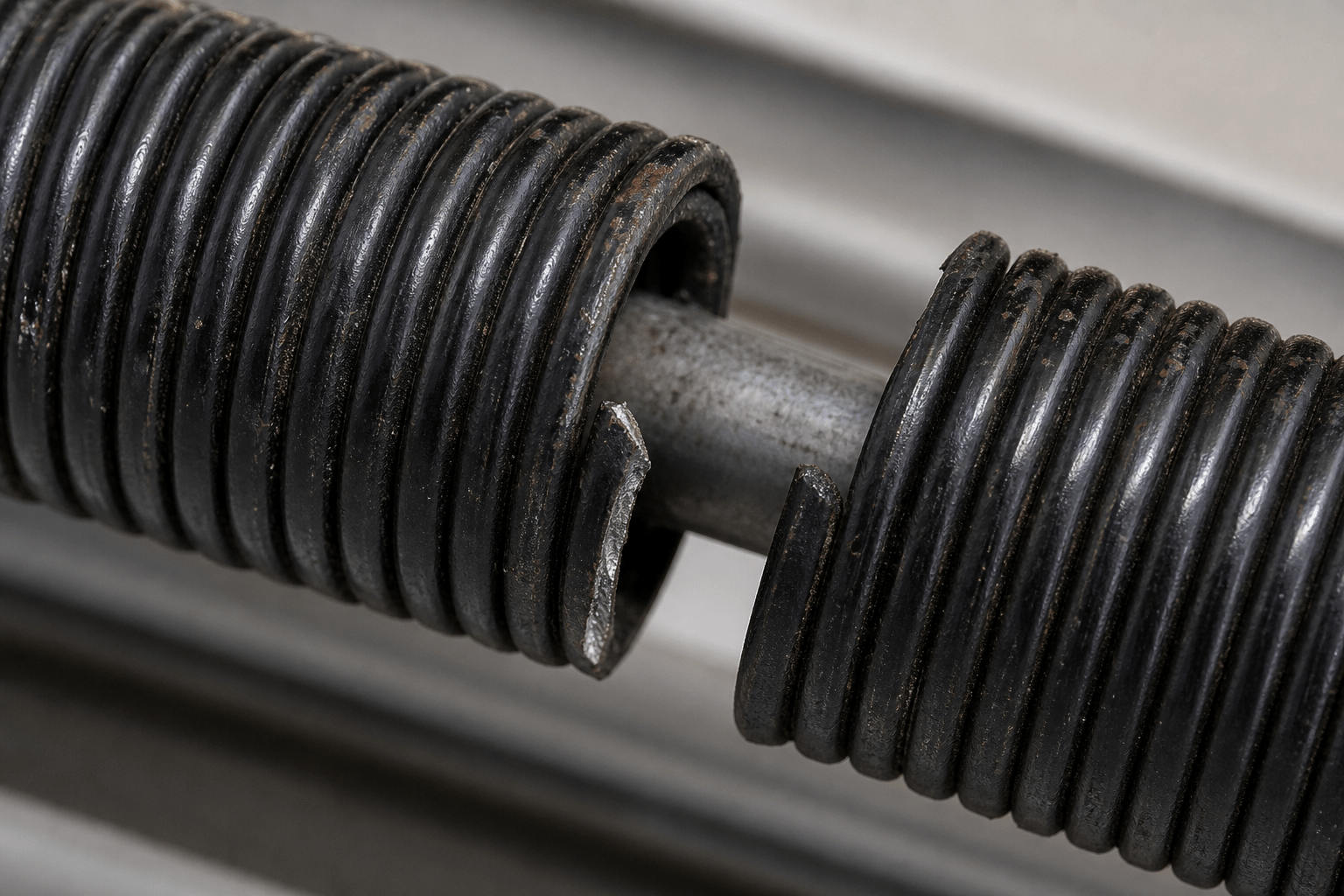
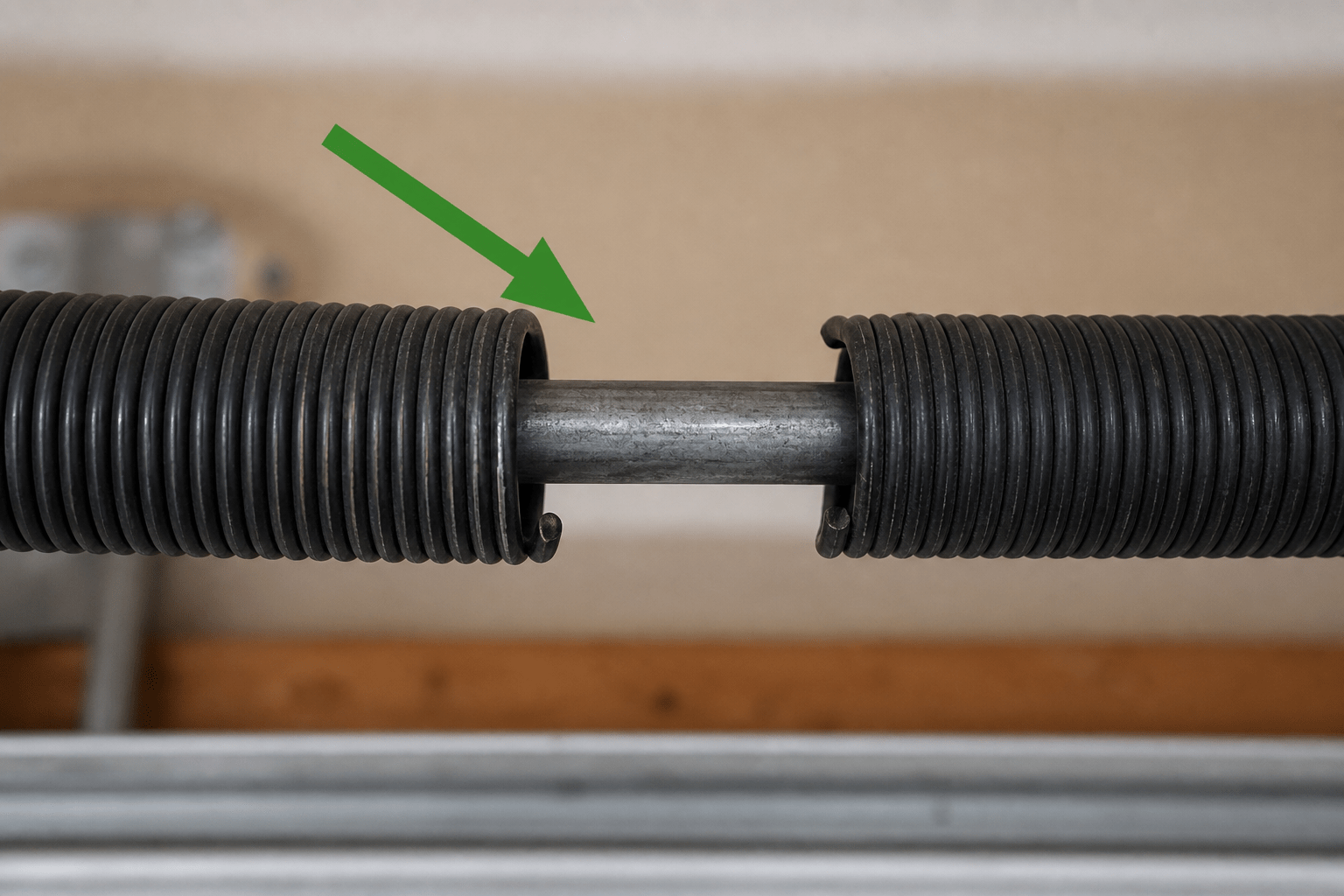
Look above the door for a torsion spring. With the door closed, look at the horizontal spring mounted on the shaft above the door. A broken torsion spring almost always shows a visible gap in the coil, the two halves will be clearly separated.
Look along the tracks for an extension spring. If your home has extension springs, one per side running along the ceiling tracks, look for a spring that’s loose, hanging at an angle, or sitting somewhere it shouldn’t be.
Try the opener. You’ll hear the motor running, but the door won’t move, or it moves only a few inches before stalling. That’s because the opener is built to assist a properly balanced door, not lift the door’s full weight on its own.
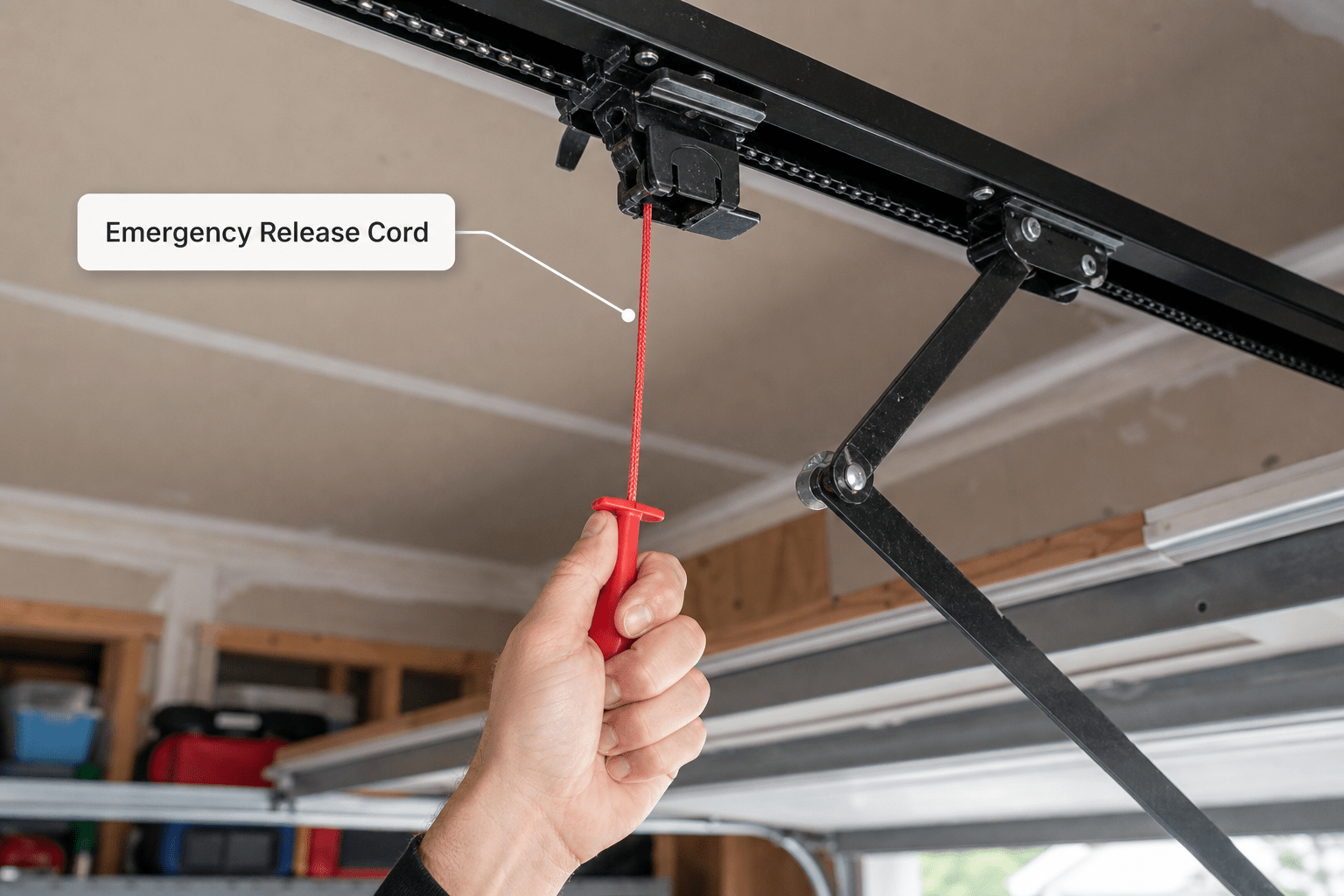
Try lifting manually. Pull the red emergency release cord to disconnect the opener, then try lifting the door by hand. A standard two-car door with a broken spring will feel extremely heavy, and often unlikely for one person to budge. That confirms the spring isn’t doing its counterbalance job anymore.
Rule out the other usual suspects. A broken cable tends to make the door sag to one side rather than stop entirely. A bad opener circuit board means the opener won’t run at all. Worn rollers make the door noisy, but it still moves. A clean stop paired with a loud bang points squarely at the spring.
If your car is inside, yes, but take a careful look first to make sure it is safe, then do it once and skip the opener entirely. If the lift cables look slack, frayed, or off the drum, do not open the door at all. Call us and we'll get the car out.
Step 1: Pull the red emergency release cord. This disconnects the door from the opener carriage so you can move it by hand.
Step 2: Get a helper if you can. A two-car door with no spring is 150 to 500 pounds of unassisted weight. One person can sometimes manage it, but two is safer.
Step 3: Lift the door manually, get the car out, and lower it back down. Prop it briefly with a solid 2x4 or have your helper hold it while the car clears the opening.
Step 4: Lock the door and leave it alone until the spring is replaced. A manual door with no spring can drop unexpectedly, especially if a cable is already fraying.
For landlords: tenants almost always try to keep using the door after spring breaks, mostly because they don't realize what actually failed. Reach out as soon as you're notified and tell them plainly not to use the opener until the spring is replaced. Opener and cable damage from a few extra cycles almost always costs more than the service call itself would have.
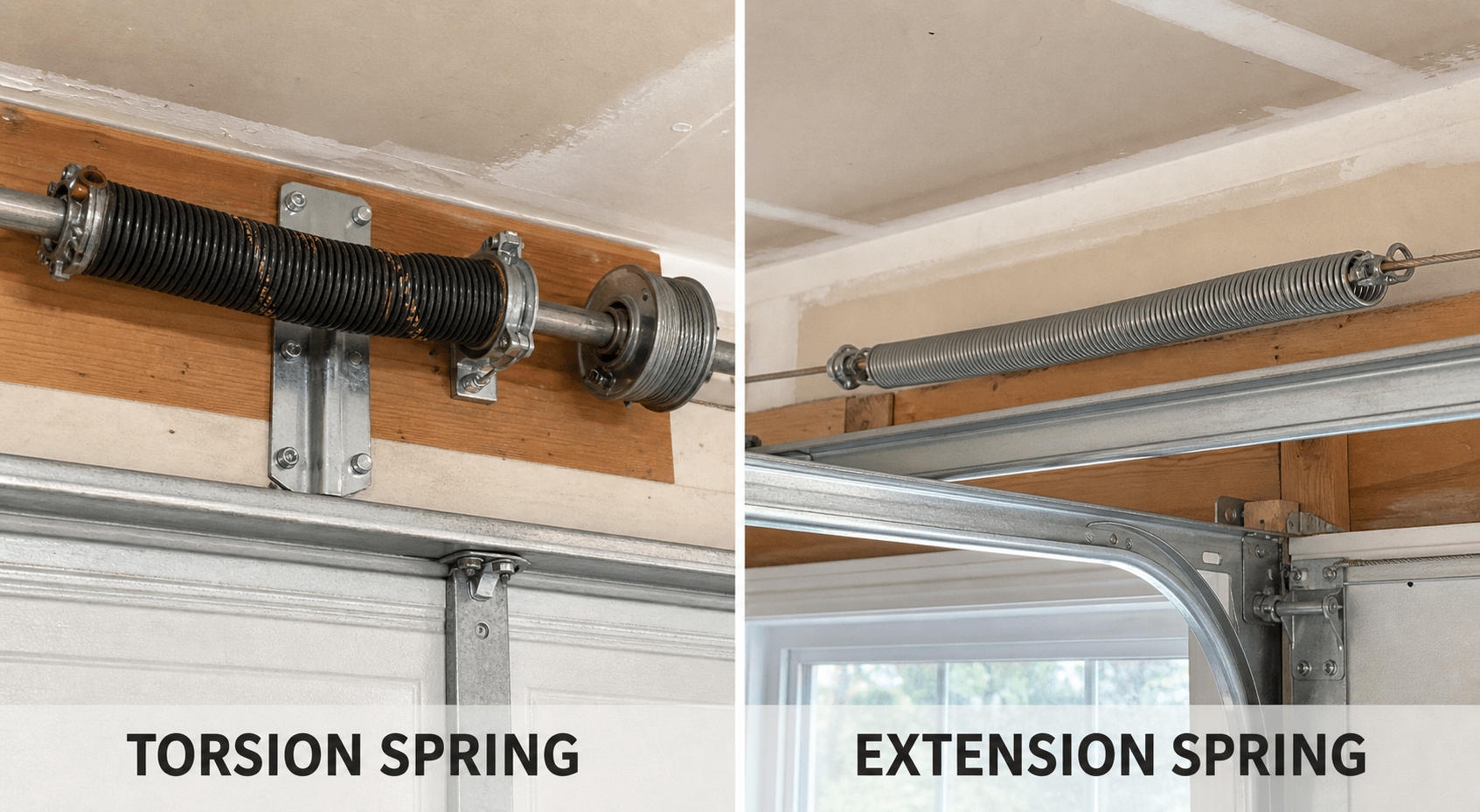
Torsion springs are the more common setup in homes built or updated since the mid-1990s. A single horizontal spring, or two on wider doors, sits on a shaft above the door. When one breaks, it stays on the shaft but shows a visible gap in the coil, and the break is usually clean.
Extension springs run along the horizontal ceiling tracks instead, one per side. When one breaks, it’ll be visibly loose, hanging, or out of position. If safety cables are installed, the spring stays contained. Without them, a snapped extension spring can cross the garage at real speed.
Quick visual check: look above the door for a gap in the coil if it’s torsion, or along the ceiling tracks for a spring that’s out of place if it is an extension.
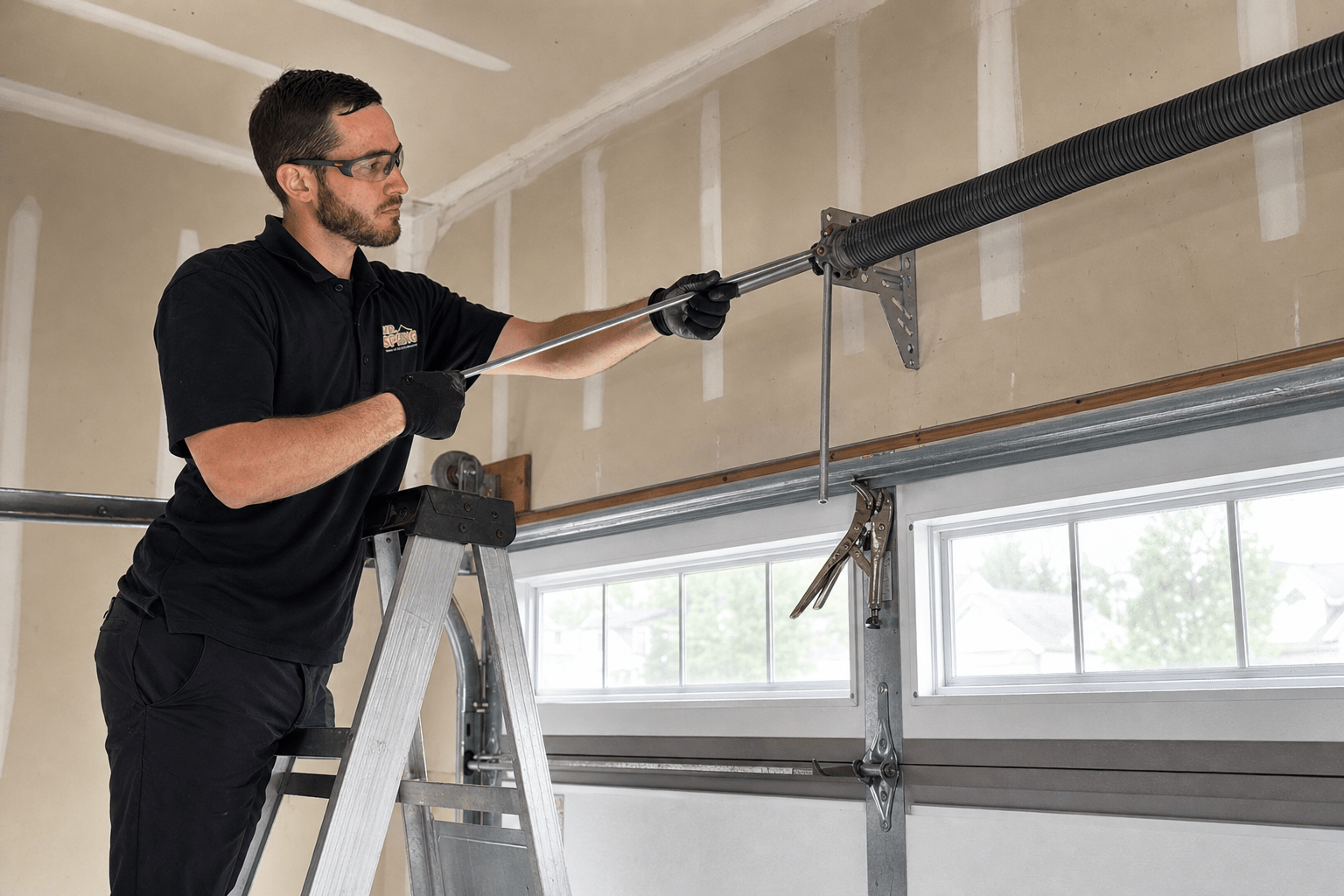
Why the type matters for the repair: torsion replacement calls for specialized winding bars and precise tension calibration. Extension spring replacement is less technical, but it still requires the correct spring sized to the door’s weight and verified safety cables. Both are professional jobs either way.
Professional torsion spring replacement in Minneapolis and St. Paul runs $250 to $600 per spring, per our own current pricing, with high-cycle springs included at the upper end of that range. Your exact price depends on the spring type and door size, which is why every job starts with a free on-site estimate.
Two doors serviced in the same visit: depends on what each door needs, so we quote it on site, but one trip charge covers both instead of two separate service calls.
Extension spring replacement: runs $200 to $450 per spring, per our own current pricing, and replacement is typically done as a full set rather than a single spring. Ask your technician for a firm, local quote on this spring type.
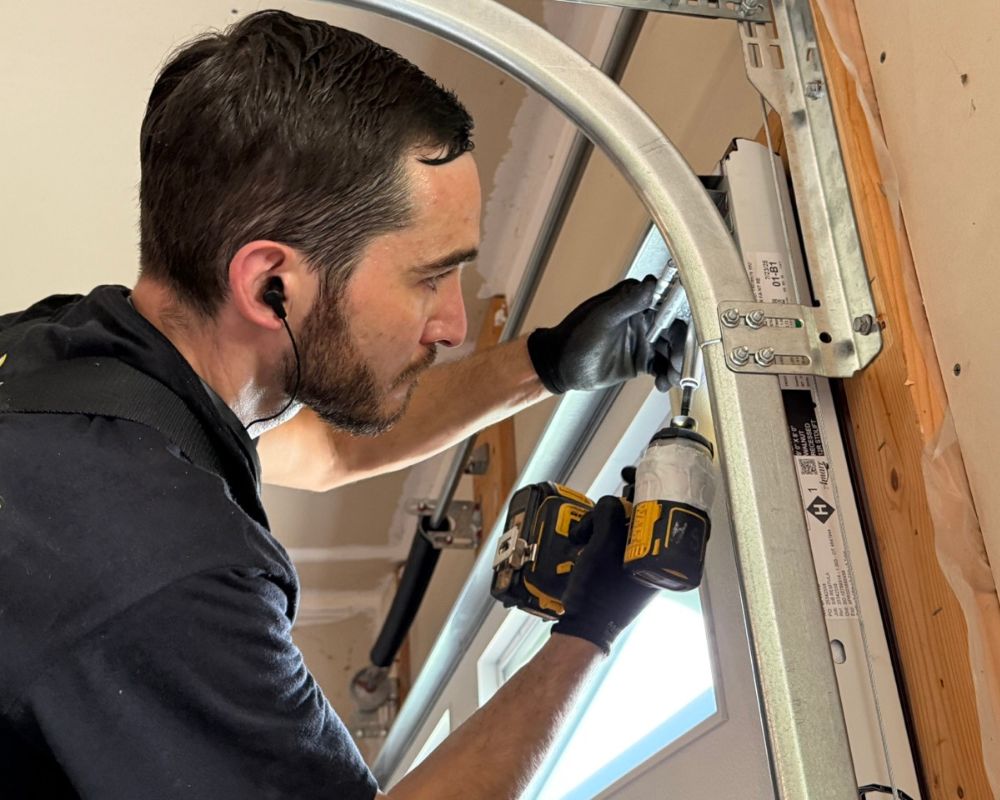
Same-day service: Our technicians arrive in a fully stocked vehicle, so most same-day jobs are handled in one visit, and every repair carries a minimum 3-year labor warranty. Our service call is free, while plenty of companies around the metro charge $29 to $150 just to come out and look. If related parts need replacing at the same time, rollers run $100 to $300 per set and cables $125 to $300 per set.
Always replace both springs. If you have a two-spring system and one broke, the other has the exact same number of cycles on it, it’s just as worn. Replacing only the broken spring means scheduling a second service call within weeks. Any reputable technician will recommend doing both.
We provide a free, no-obligation estimate before any work starts, and if something isn’t right after the repair, we’ll send a technician back at no additional charge.
Always replace both on a two-spring system. Springs wear at the same rate, so if one snapped, the other is at or near the same point in its cycle life. Replacing only the broken one saves nothing meaningful, you’ll be booking a second service call for the other spring within weeks, paying two trip charges instead of one.
Technically possible, but genuinely risky for anyone without prior spring replacement experience. Torsion springs store 200 to 300 pounds of mechanical energy, and if a winding bar slips during the process, that energy releases instantly, a real risk to hands and wrists that professional technicians are trained and equipped to avoid. Professional garage door spring repair runs $250 to $600 per spring, whether one or both springs need replacing, far less than the cost of an ER visit.
Most of our spring replacements take 45 minutes to an hour, according to our own service data, since common spring sizes are stocked on the truck and there’s no need to source the part on site. The door is tested and fully operational before we leave.
That loud bang and a stuck door almost certainly mean a broken spring. Confirm it visually, stop using the door, and get it fixed before running the opener again.
Garage door spring replacement in Minneapolis and St. Paul runs $250 to $600 per spring, well below the cost of a burned-out opener, a frayed cable, or a door that comes off its track.
We offer same-day garage door spring replacement across Minneapolis and St. Paul, backed by a free estimate and our fix-it-right guarantee. Call us at (612) 416-0091 as soon as you’ve confirmed the spring is broken and we’ll have it fixed today.
About the Author
Tyler Kurr is the general manager of Mr. Spring Garage Doors, serving Minneapolis and St. Paul. The company was built to fix what homeowners dread about garage door service, unanswered calls, unclear pricing, and missed appointments from other companies. We built Mr. Spring around the opposite: upfront pricing, on-time service, and a guarantee that if a repair isn’t done right, we send a technician back at no charge. Mr. Spring holds a 5.0-star rating across 1,300+ reviews.
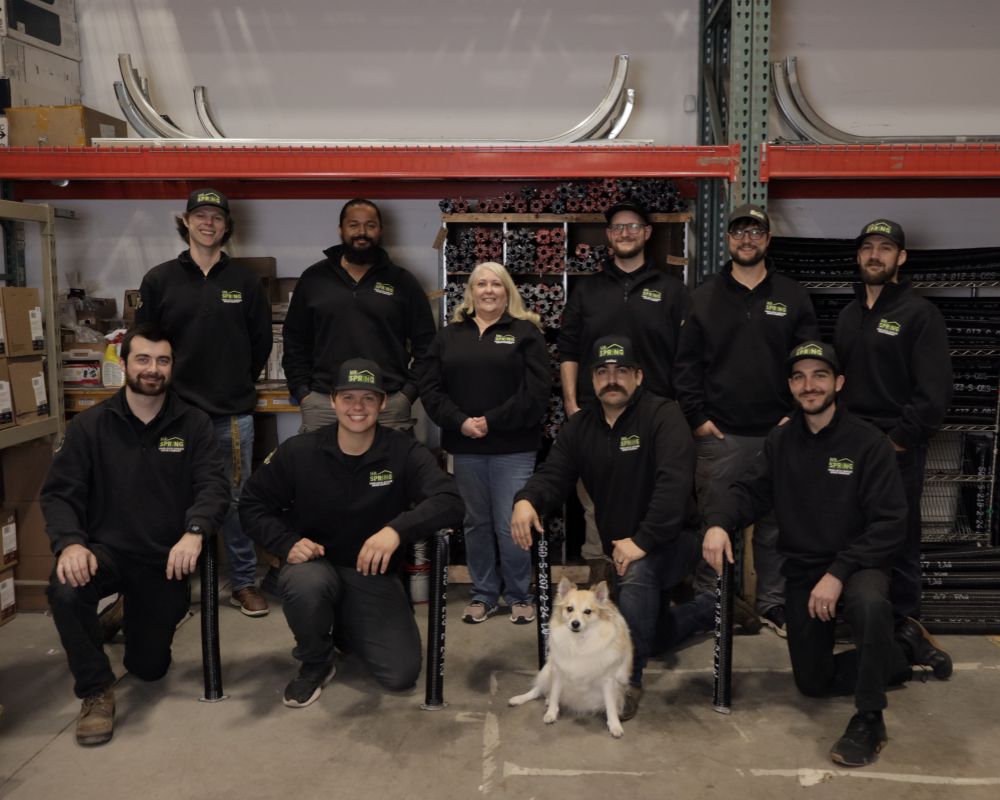
At Mr. Spring Garage Doors, we don't perform surface-level tune-ups. We deliver detailed inspections designed to catch issues early and prevent costly system failures. Our technicians are trained to identify wear patterns that less experienced providers often miss, helping you avoid unnecessary repairs and replacements.
Preventative maintenance is not an upsell. It is a smart investment in reliability, safety, and long-term cost control. Waiting for a breakdown often leads to more extensive damage and higher repair costs.
We are a locally owned and operated business serving the Twin Cities metro. Our owner, Joe Schwartz, is a lifelong Minnesotan who understands firsthand the demands that Minnesota weather places on garage door systems year-round. Every maintenance visit we perform is built around protecting your system for the long haul, not just getting through the call.
If your garage door has not been professionally serviced within the past year, now is the time. Schedule your maintenance today and keep your system running smoothly while avoiding unexpected expenses.